

Ask Me Anything: Writing Edition
Your writing questions, answered!

I recently posted an AMA on Instagram and I got a lot of great questions…and as you might expect, a lot of them were about writing! So I’m going to tackle some of those today and hopefully demystify the process for you a little bit. But just as a reminder, this is where I’m at with writing advice:
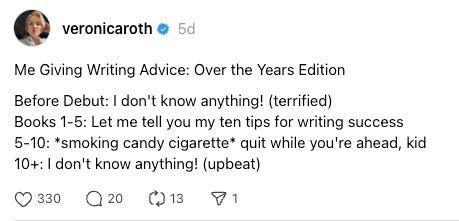
The best writing advice I can possibly give you is to do what works for you, and “what works” will probably change with each story you write. There’s no correct path to writing a book, there’s just whatever path gets you to the end.
With that said, here we go!
What’s the most enjoyable thing about the writing process for you? What’s the least enjoyable?
I like every part of it to a certain extent. But my favorite part of writing is the first round of revisions. That’s when I have a draft, so I know my story’s shape and I’ve gotten to know its characters…but now I get to discover the hidden potential of that story and bring it to the surface. I find that process—finding the strongest version of the story I’ve written and revealing it—to be the most rewarding part of writing.
The least enjoyable part for me is line edits. Line edits come after I’ve made the big revisions I wanted to make but before copyediting (which is when you correct errors in continuity, grammar, punctuation, etc.). Line edits are more granular than revisions/developmental edits but they are still highly subjective; they’re when you get asked things like “would she really say it that way?” or “how does this character know about X thing?”. I don’t know why, because I’m not particularly sensitive to criticism at any other stage, but I find line edits infuriating. (Necessary, though.)
How has the act of publishing changed your outlook on writing, if it has?
I think if you’re paying attention, the longer you work in the publishing industry the less you believe it’s a meritocracy. Good books don’t always succeed; successful books aren’t always good. For a lot of people, this revelation comes with no small amount of grief. It feels profoundly unfair that you can have a great idea, work really hard on it, do everything you can to give it a good start in the world, and still watch it fail while other books—boring books, books you hate, books by authors who were profoundly unkind to you, etc.—do extremely well. And if you’re not careful, you can get really worn down by that, and it can turn you bitter and cynical or even put you off writing entirely. (Or on the flip side, if you’re successful, you might start to drink your own Kool-Aid. Realizing it’s not a meritocracy is what will help you keep a good head on your shoulders in the midst of success, my friends. Ask me how I know.)
The industry has largely been good to me, though there have been challenges. I can’t say the same for everyone I care about, and that is particularly disheartening. But if you love writing, that will buoy you along through all the storms. I try to make my work better, not because I think it’ll necessarily make the book sell better (though it might, I guess?), but because I care about growing as a person and as a writer. Our culture wants you to think that if it doesn’t make money, it’s not worth doing; writing reminds us, daily, that that’s a lie.*
*There’s a big, huge caveat here: I think it’s important for writers to be fairly compensated for their labor and for them to fight for that fair compensation. Often when you are practical or market-minded in this business, people accuse you of being a sellout or “just doing it for the money,” and that is some bullshit. No one argues that people in less creative industries should not get paid for their time and effort, but people devalue creative work all the time. So my comments above are an attempt to answer the question “if this isn’t making money or serving a practical purpose, is it still okay for me to do it?”, and nothing else.
How has moving affected your writing?
Honestly the biggest challenge after moving last year is that my elderly dog is more restless in this new place, and she bothers me constantly, which means it’s hard to get into a flow state. It got so bad that when I was on a really tight deadline this past fall, I actually asked a family member to watch her for an entire month. (Thank you to them for doing it.) It helped a lot, and I met my deadline. I love my sweet little pup and I also—stage whisper—despise her sometimes.
How much time per day do you write?
It mostly depends on what stage of the writing process I’m in. When I’m deep into a draft, I will sometimes write for eight to ten hours a day. When I’m starting out, I have days where I struggle to write for ten minutes. That’s the thing about writing a book—your good days, your bad days, they all even out in the end.
Do you write your first draft by hand or write on a computer?
I don’t even write grocery lists by hand! My handwriting is atrocious and I think way too fast for my hand to keep up. Sometimes I outline in a notebook because I like to draw flow charts for outlines, but that’s about it.
How do you deal with writer’s block?
I don’t stress about it. I take a break, take a walk, try to figure out why I’m stuck. Talk it out with a friend, whatever feels good. Then I go back to the last place I felt like the draft was “working” and try something different—change the plot, write from a different POV, skip a scene, whatever. If that doesn’t work I try something else. And something else. And something else. The trick is to think of this experimentation as playful instead of despairing over it. (It helps if you’re not working on a tight deadline, but honestly, I still do it—because if I’m stuck, I’m wasting just as much time as I’d waste by playing around, so why not try out new things?)
What advice would you give to someone who struggles to create an outline for a story?
Two things. One, are you sure you need to outline? Not every writer does, and if it’s stalling your progress you should absolutely give up on outlining and just start writing instead. The important thing is to start creating, whatever that means for you.
But two, if you need to outline but still find it difficult, you should check out my video on Big Scenes.
When did you know you wanted to be an author? What would your job be if not an author?
I don’t remember ever thinking “I want to be an author”...it was more that “I want to write books” and “I need money to pay for food and rent” collided. And the thing about writing books is that you can do it even if no one pays you for it. So there’s no world in which I’m not writing books. If I wasn’t getting paid enough to do it full time, though, I’m not sure what I would be doing. I recently read an author’s argument for, if you like to write, working at a job that doesn’t deeply engage you (I think it was George Saunders? Unclear). That way you can leave it fully behind you when you’re done for the day, and write in your free time. There’s probably something to that, though I don’t think it’s a requirement or anything.
Any advice for debut writers?
Make friends. Writing is lonely and it helps to have colleagues—not just critique partners, but other people working in the same segment of the industry. It especially helps to share information about the industry and your experience with your publisher. There’s no point in being competitive with other authors—we’re all in this boat together, and when one of us does well, the rest of us benefit. Just as an example: if a celebrity’s book or a really huge BookTok book gets people into the bookstore, they might pick up something else that catches their eye, and that’s a win for all of us.
Also, try not to read reviews. You won’t be able to resist this temptation perfectly, but it will probably make you miserable, and it’s not actually important. Start writing something else, instead. You’ll grow more in your writing by doing that than by listening to every single voice on the Internet.
I’ll be back with non-writing Q&As in the near future! Thanks for your questions! (Also, as always, feel free to ask more in the comments if you’ve got ‘em!)
—V
I hope you will wrote another book in the Divergent universe sometime!!
Love these books so much!
One thing that I would ask is...
When I write stories, I usually start really strong. I know what the plot will be, I know the characters, and I know what I want to happen. The big things. But with every story that I start, I end up getting stuck, because I don't know how to make good filler in between the key points in the plot. And then, when I don't have any ideas of what to add to keep the story going, I end up just giving up because I have no motivation. So I am just wondering if you have any advice for that kind of problem, and how to keep going without just giving up?